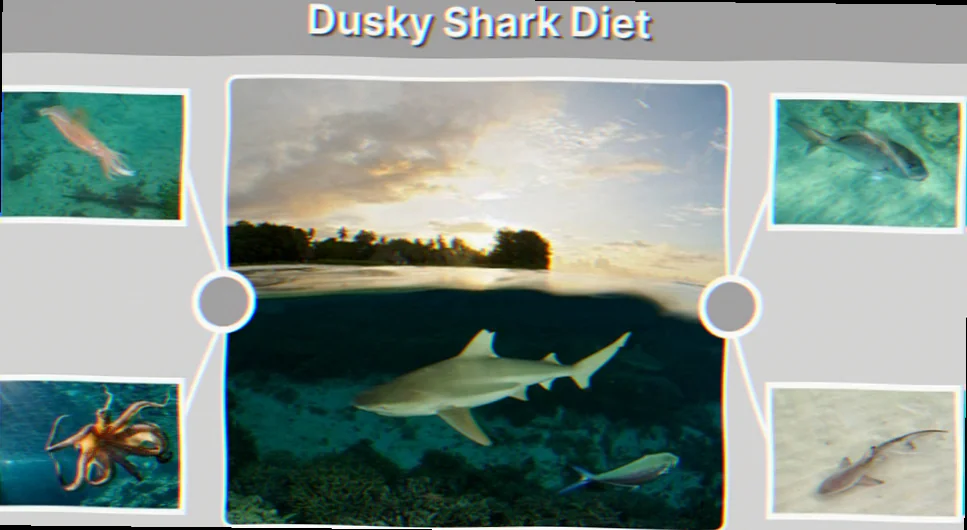
Dusky whaler shark diet composition analysis involves studying the stomach contents and stable isotope signatures of sharks to understand their prey preferences and trophic role within Australian marine ecosystems. These analyses are crucial for assessing the ecological impact of the dusky whaler shark, Carcharhinus obscurus, a widespread species in temperate and tropical waters around the Australian coastline. Understanding what they eat helps inform conservation efforts and fisheries management by revealing their position in the food web and potential interactions with commercially important species.
Scientific Classification and Description
Animalia → Chordata → Chondrichthyes → Carcharhiniformes → Carcharhinidae → Carcharhinus → Carcharhinus obscurus.
Adult dusky whaler sharks are large, robust predators. Mature individuals typically range from 2.5 to 3.5 metres in total length, with exceptional specimens exceeding 4 metres. Their weight can vary considerably depending on age and condition, but large adults can weigh upwards of 200 kilograms, with some recorded at over 300 kilograms. They possess a streamlined body, a broad, flattened head, and a distinctive interdorsal ridge. Their dorsal fins are relatively tall and falcate (sickle-shaped), with the first dorsal fin originating posterior to the pectoral fin insertion. The caudal fin is asymmetrical, with a pronounced upper lobe.
Identifying Features at a Glance
| Feature | Detail |
|---|---|
| Scientific name | Carcharhinus obscurus |
| Size (adult) | 2.5 - 4.3 metres total length; 200 - 300+ kg |
| Endemic range | Coastal and continental shelf waters of temperate and tropical Australia, including Western Australia, South Australia, Victoria, New South Wales, and Queensland. Also found in the Northern Territory. |
| Conservation status | IUCN: Near Threatened; EPBC Act: Vulnerable |
| Lifespan | Estimated 40-50 years in the wild. Limited data from captivity. |
Habitat and Distribution in Australia
- Primary biome: Benthic and pelagic zones of temperate and tropical marine environments, favouring continental shelf and slope areas.
- Geographic range: Found throughout Australian waters, from the temperate south coast (e.g., South Australia, Victoria) to the tropical north (e.g., Queensland, Northern Territory, Western Australia). They are also present in the Indo-Pacific region.
- Microhabitat: Often found over sandy or muddy bottoms, near reefs, and in deeper waters, but also in bays, estuaries, and nearshore waters, particularly when young.
- Altitude / depth range: Typically inhabit depths from the surface down to approximately 400 metres, with juveniles more commonly found in shallower waters.
- Seasonal movement: Exhibit some seasonal migration, with individuals moving between warmer and cooler waters, and potentially to nursery grounds for pupping. For instance, pregnant females may move to specific sheltered bays for parturition.
Diet, Hunting, and Feeding Ecology
The diet of the dusky whaler shark is varied and opportunistic, reflecting its position as an apex predator. Analysis of stomach contents and stable isotope ratios reveals a primary consumption of bony fishes, including various species of snapper, trevally, mullet, and herring. They also consume cartilaginous fishes like smaller sharks and rays, cephalopods such as squid and octopus, and occasionally crustaceans. Juveniles tend to feed on smaller, more abundant prey, shifting to larger fish and elasmobranchs as they mature. Their feeding strategy is primarily active pursuit and ambush. A unique foraging behaviour observed is their tendency to hunt in aggregations during periods of high prey abundance, such as mass fish spawning events, where they can efficiently exploit concentrated food resources. This cooperative hunting, while not fully understood, suggests a level of social coordination or opportunistic exploitation of shared feeding opportunities.
Reproduction and Life Cycle
Reproduction in dusky whaler sharks is ovoviviparous, meaning the eggs hatch within the mother's body, and the young are born live. The breeding season is not strictly defined but often coincides with warmer months. Litter sizes are relatively small, typically ranging from 3 to 16 pups. Gestation periods are lengthy, estimated to be around 10 to 12 months. Pups are born in sheltered coastal nursery areas, often in bays or estuaries, where they have access to abundant smaller prey and protection from larger predators. Juvenile development involves a period of rapid growth in these nursery habitats, with age at sexual maturity being quite late, estimated to be between 15 to 20 years for females and slightly earlier for males, reflecting their long-lived nature.
Unique Adaptations Exclusive to This Species
- Physiological adaptation 1: Highly efficient osmoregulation allowing them to tolerate a wide range of salinity in both open ocean and estuarine environments, facilitated by specialized rectal glands and kidney function.
- Behavioural adaptation 2: Maternal care through the selection of protected nursery grounds for pupping, which significantly increases the survival rates of vulnerable neonates by providing reduced predation pressure and abundant food sources.
- Sensory adaptation 3: Possess ampullae of Lorenzini, specialized electroreceptors distributed across their snout and ventral surface, enabling them to detect the faint electrical fields generated by the muscle contractions of prey, even when hidden beneath sand or in murky water.
Threats, Conservation, and Human Interaction
The dusky whaler shark faces several significant threats. The top three include:
- Overfishing: They are often caught as bycatch in commercial fisheries targeting other species, and their slow growth and late maturity make them particularly susceptible to overexploitation.
- Habitat degradation: Coastal development and pollution can impact their nursery grounds, reducing breeding success and juvenile survival.
- Climate change: Shifts in ocean temperature and prey distribution can alter their foraging grounds and migration patterns, potentially leading to food scarcity and increased competition.
Frequently Asked Questions
Is the dusky whaler shark venomous or dangerous to humans?
No, the dusky whaler shark is not venomous. While it is a large predator and possesses a powerful bite, attacks on humans are extremely rare. They are generally not considered aggressive towards people, and encounters typically occur when they are attracted by bait or fishing activity. Their behaviour is more likely to be defensive if cornered or provoked.
Where is the best place in Australia to see dusky whaler shark diet composition analysis in the wild?
While observing the diet composition analysis itself is not possible visually, one can observe dusky whaler sharks in their natural habitat. Good locations to potentially encounter dusky whaler sharks in Australia include the waters off the coast of Western Australia, particularly around the Recherche Archipelago and the Dampier Archipelago, and in parts of South Australia, such as the waters around Kangaroo Island, known for its rich marine biodiversity and shark populations. Dedicated shark diving tours in these regions offer opportunities to see them in controlled environments.
What is the difference between the dusky whaler shark and similar species?
The dusky whaler shark (Carcharhinus obscurus) is often confused with other large carcharhinid sharks, most notably the bull shark (Carcharhinus leucas) and the blacktip shark (Carcharhinus limbatus). Key differences include the dusky whaler's longer, more pointed snout, its distinctive interdorsal ridge, and its larger size at maturity compared to blacktip sharks. Unlike bull sharks, dusky whalers have a much more pronounced interdorsal ridge and a less broad, more acutely pointed snout. Their fin shapes and relative proportions also differ, with the dusky whaler having taller, more falcate dorsal fins than bull sharks.