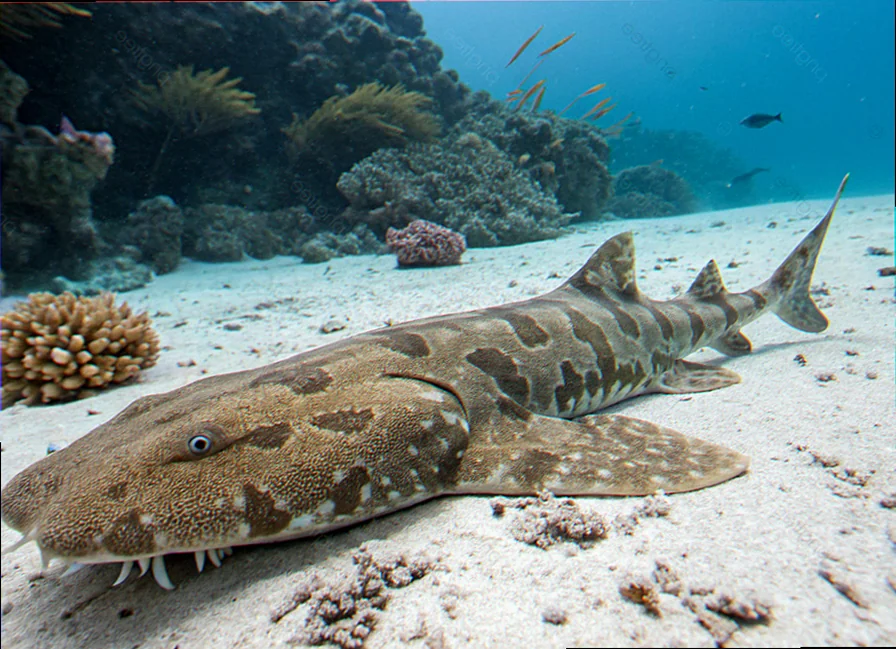
Field impression: Below the surging foam of a sandstone ledge, the seafloor appears as a static tapestry of encrusting sponges and swaying kelp holdfasts. It is only when a golden, unblinking eye rotates within a patch of lichen-like skin that the "living carpet" reveals itself, scentless and silent amidst the rhythmic thrum of the Pacific swell. There is no movement to betray its presence, only the sudden, jarring realisation that the rock you were inspecting is actually a sophisticated apex predator.
How to Identify Wobbegong shark camouflage tactics
| Feature | What to Look For |
|---|---|
| Body shape | Extremely flattened (dorsoventrally compressed) with a broad, rounded head. The silhouette is broken by a "fringe" of dermal lobes (tassels) around the jawline. |
| Colouration | Intricate, mosaic-like patterns of "shattered" symmetries. Expect concentric circles, dark saddles, and lichen-esque blotches in shades of mustard, chocolate, and cream. |
| Size compared to common object | Varies by species; a Spotted Wobbegong (Orectolobus maculatus) can reach 3 metres, roughly the length of a small kayak, while the Ornate Wobbegong is closer to the length of a standard park bench. |
| Voice / sound | Entirely silent. However, a "thump" may be felt through the water column if a large individual suddenly beats its muscular tail to reposition. |
| Tracks / signs | "Shadow-less" depressions in the sand within rocky gutters; occasionally, a pile of discarded crayfish carapaces or octopus beaks near a preferred "sit-and-wait" cave. |
Where and When to Find It
Wobbegongs are quintessential residents of the Great Southern Reef and the tropical north. To observe their camouflage in action, focus on high-energy surge zones and limestone reef platforms. In New South Wales, Cabbage Tree Bay (Manly) and the gutters of Jervis Bay are world-class locations. In Western Australia, the limestone overhangs of Rottnest Island and the coral "bommies" of Ningaloo provide excellent vantage points. While they are present year-round, the larger Spotted Wobbegongs are most visible in the cooler months (May to August) when they move into shallower water for breeding. Look for them in "micro-features": horizontal crevices where the ceiling is less than 30cm high, or tucked directly into beds of Sargassum seaweed where their patterns mimic the dappled light filtering through the canopy.
Behaviour Worth Watching
- Unique behaviour 1: The "Caudal Lure" Twitch. While most field guides describe the Wobbegong as a passive ambush hunter, I have observed the Spotted Wobbegong (O. maculatus) using its tail in a highly predatory manner. The shark will slightly elevate its posterior and perform a rhythmic, worm-like twitch of the caudal fin tip. This mimics the movement of a small, distressed fish or polychaete worm, successfully drawing in curious "mado" or "sweep" fish directly toward the shark's mouth.
- Unique behaviour 2: Dermal Flap Orientation. The "tassels" or dermal lobes around the Wobbegong's snout are not merely decorative; they are active camouflage tools. In areas of high water movement, the shark will subtly shift its head to ensure these lobes flutter in perfect synchronicity with the surrounding macroalgae. This prevents the "static object" giveaway, where a motionless animal stands out against a moving background. It is a form of active mimicry of the local hydrodynamics.
- Social structure: Generally solitary and highly territorial regarding specific "resting" ledges. However, during the austral winter, you may find "piles" of Wobbegongs (up to six or seven individuals) stacked atop one another in a communal thermal-regulation or social display, though they do not hunt cooperatively.
- Defensive display: If provoked, the Wobbegong does not flee. It performs a "snap-turn," a lightning-fast 180-degree lateral flex. Because their bodies are so flexible, they can bite their own tails, making them extremely dangerous to handle for the uninitiated naturalist.
- Activity pattern: Primarily nocturnal hunters. During the day, they rely on "cryptic crypsis" (total stillness) to avoid detection by larger predators like Great White Sharks. At night, their camouflage shifts purpose, allowing them to crawl along the seafloor undetected by their prey.
Ecological Role in the Australian Landscape
The Wobbegong is the "janitor and judge" of the reef floor. By occupying the niche of a benthic ambush predator, they regulate the populations of mid-sized crustaceans and cephalopods. Without Wobbegongs, populations of crabs and octopuses could potentially over-graze local gastropod populations or small reef fish. Their camouflage is the mechanism of this regulation; it allows them to remove the "unwary" from the gene pool. Furthermore, their skin often hosts specific species of isopods and remoras, creating a mobile micro-ecosystem. When a Wobbegong sheds its skin or dies, the nutrient-dense dermal denticles contribute significantly to the local calcium carbonate cycle on the reef floor.
Lookalikes and How to Tell Them Apart
Epaulette Shark (Hemiscyllium ocellatum): Often confused with juvenile Wobbegongs due to their spots. However, the Epaulette Shark has a much more slender, eel-like body and lacks the distinctive dermal "tassels" or fringe around the mouth. It also "walks" using its pectoral fins much more overtly than the Wobbegong.
Port Jackson Shark (Heterodontus portusjacksoni): While it shares the same habitat, the Port Jackson has a distinct pig-like snout, high dorsal spines, and a harness-like pattern of dark lines rather than the shattered mosaic camouflage of the Wobbegong. It lacks any fringe or tassels.
Conservation Notes for the Field Naturalist
While most species of Wobbegong are currently listed as "Least Concern" or "Near Threatened," they are highly vulnerable to localized depletion. Because they are "site-attached" (remaining in the same small area for years), they are easily targeted by spear-fishers or accidentally caught in lobster pots. As a citizen scientist, you can help by using apps like iNaturalist to record sightings, particularly noting the health of their skin. Look for "tassel-thinning" or unusual lesions, which can be indicators of declining water quality in urbanised estuaries like Botany Bay or Sydney Harbour.
Common Questions from Observers
What does Wobbegong shark camouflage tactics eat and how does it hunt?
Their diet is broad, including reef fish, octopuses, crabs, and even smaller sharks. Their hunting technique is a masterclass in physics: the shark waits for prey to wander within inches of its mouth. Using a massive buccal (mouth) cavity, it expands its throat instantly, creating a vacuum that sucks the prey in. The camouflage ensures the prey never sees the "vacuum" coming. Their backwards-curving, needle-like teeth ensure that once a prey item is gripped, escape is physically impossible.
Is Wobbegong shark camouflage tactics nocturnal?
Yes, they are primarily nocturnal. During the day, their camouflage is a defensive tool to hide from larger sharks and seals while they conserve energy. At night, they become more active, though they still use a "stop-and-start" movement pattern. They move a few metres, settle, and blend into the new patch of reef, waiting for a few minutes to see if any prey crosses their path before moving again.
Can Wobbegong shark camouflage tactics be found in suburban gardens?
While you won't find them in a backyard pool, they are remarkably "urban" sharks. If you live near a rocky coastline in Sydney, Perth, or Brisbane, they are likely living just meters from the shore. They frequently inhabit the pylons of busy ferry wharves and public ocean baths (like the Bronte or Bondi baths), where they hide under the stairs or along the sea walls, perfectly camouflaged against the barnacles and algae.